The Headline Version
On October 21, PHP released fixes for two critical vulnerabilities in its core engine (PHP Foundation, 2026). PHP is a programming language that runs on most web servers and builds web pages before they reach your screen. Some websites temporarily suspended services while operators patched, according to CNN reporting carried by ABC7 Chicago (Eadicicco & Ziady, 2026). PHP powers WordPress, Drupal, and Wikipedia's MediaWiki; Wiz estimates that it is used by about 70% of websites. That is a measure of PHP use, not a count of websites proven exploitable (Tzadik et al., 2026).
The headline on most of the coverage was the same: AI found it.
That is true, but it is half of the story. The other half is that these were longstanding flaws in software people had already built and deployed (PHP Foundation, 2026). Nobody wrote it last week. Nobody trained a model to plant it. People wrote it, people shipped it, and people ran it for years.
I am writing this one because I keep hearing a version of the story that goes "AI bad" and "AI is breaking the internet." I think it is more accurate to say AI is turning on the lights.
What Actually Happened
Here is the short version: Calif used OpenAI's GPT-5.6 Sol to identify a critical flaw, and Wiz independently reported both vulnerabilities (OpenAI, 2026c). The PHP maintainers led the fixes and the release.
There is an important piece of history here. The PHP Foundation says a developer found signs of the out-of-memory problem in 2024. A fix stalled amid compatibility tradeoffs, a difficult decision process, and limited staff. Later reports made the full impact clear (PHP Foundation, 2026).
The bugs are memory safety problems. Fatal errors, including running out of memory, could leave internal state that a later request would trust even though it was no longer valid (PHP Foundation, 2026).
Think of a job site. The last crew tears out a wall but leaves the blueprint on the table showing the wall still standing. The next crew trusts the blueprint and builds based on that old information. Eventually, somebody gets hurt. In software, the consequences can include reading private memory or running an attacker's code. Wiz demonstrated attacks against current WordPress, Drupal, and Joomla container images. Even a simple "Hello World" page can be vulnerable under affected conditions; the application does not have to contain its own bug (Tzadik et al., 2026).
So what did AI change? Not the existence of the bug. It changed the work of proving and adapting an exploit. Wiz says one researcher with frontier models completed in a week work that previously would have taken a world-class team months. That is Wiz's assessment, not a controlled comparison, but it is a serious warning (Tzadik et al., 2026).
Meet Human Slop

I am using "human slop" with a wink. Most of the people who wrote this kind of code were skilled, often volunteers, working in languages that make this class of mistake easy. But the point stands: the mistakes are ours.
And they are not rare. In 2019, Microsoft reported that roughly 70% of the vulnerabilities it assigned a CVE each year involved memory safety (Microsoft Security Response Center, 2019). Chromium's published analysis likewise put memory safety at about 70% of its serious security bugs, based on 912 high- or critical-severity bugs affecting its Stable channel since 2015 (Chromium Project, n.d.). Those are historical findings, not measurements of all software in 2026. A joint government report published in 2025 put Microsoft's more recent proportion at approximately half (CISA et al., 2025).
The lesson is not that every famous vulnerability is the same kind. Heartbleed and Log4Shell are useful comparisons for the reach of a shared software failure, but Apache describes Log4Shell as a JNDI lookup vulnerability, (Java Naming and Directory Interface. It is a Java API that allows applications to discover and look up data and objects via a name) not a memory safety bug. Nor does any of this establish that AI generated code is free of mistakes.
The same pattern shows up in the other big AI security story of this year. In April, Anthropic announced Project Glasswing and reported that its then-unreleased Claude Mythos Preview model found thousands of high-severity flaws, including a 27 year old bug in OpenBSD (an operating system famous for being hardened, often used to run firewalls and other critical infrastructure) and a 16 year old bug in FFmpeg (open-source software that processes video and audio, and sits behind a huge number of apps and streaming services) that automated testing tools had hit five million times without catching (Anthropic, 2026).
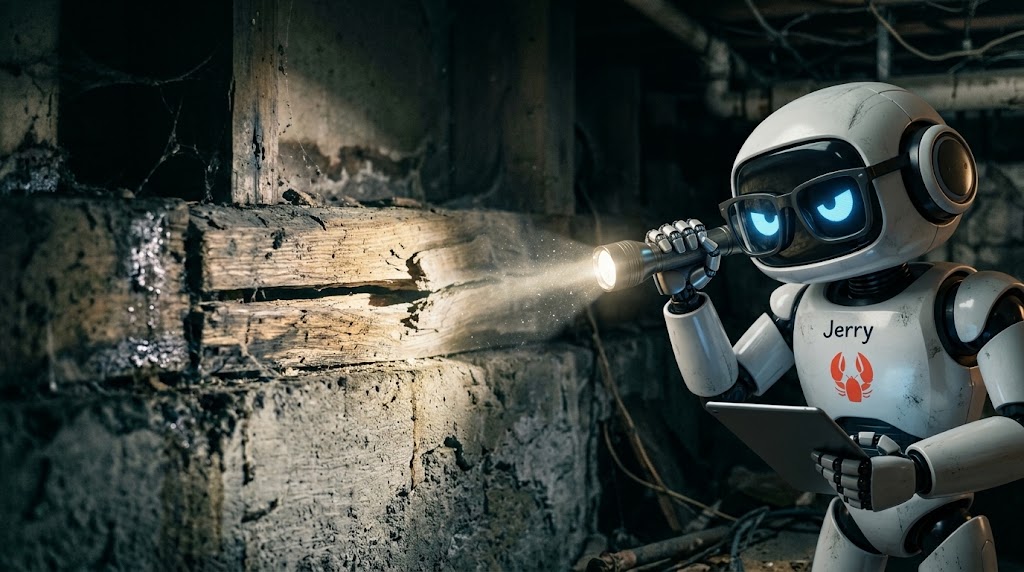
Twenty-seven years. That bug outlived entire careers of human reviewers. A home inspector with a better flashlight did not rot the sill plate. The flashlight just showed us problem.
The Part I Won't Wave Away
Pretending there is no downside would be dishonest, and I would not trust a pro AI article that did.
The same capability that helps a defender helps an attacker. Wiz says lowering the effort needed to build and adapt exploits makes attacks easier to scale (Tzadik et al., 2026). OpenAI says the same thing in its own announcement, that these capabilities can help attackers rapidly build offensive tools (OpenAI, 2026c). A flaw that was too hard to exploit last year may not be too hard this year.
But look at who got there first this time. OpenAI's statement was that, to its knowledge, "frontier AI found these vulnerabilities before attackers did" (OpenAI, 2026c). That gave maintainers and security vendors preparation time, although the PHP Foundation reports that leaks disrupted the planned disclosure and brought the release forward by a day (PHP Foundation, 2026). OpenAI calls this a Defender's Window, and it has committed $1 billion in subsidized access for defenders with limited resources (OpenAI, 2026c). The race is real. The question is who runs it faster, and right now I would rather the defenders have the tools than leave them to the attackers alone.
The Bank Story

You may have seen the headlines that AI agents are "logging in to bank accounts." I read the coverage, and the reality is more ordinary and more interesting.
October reporting described banks detecting third-party agents using customer credentials, with some behavior appearing to go beyond customer instructions. Decrypt attributes those findings to Axios and its sources (Decrypt Staff, 2026). Customer permission and bank permission are different things. An agent can have one without the other, and these reports do not by themselves establish that every bank was hacked.
So what is one actual problem? A person handed their password to a piece of software. That does not establish a safe boundary around what the software can do. Reporting on JPMorgan distinguishes blocking credential-based agent logins from allowing limited data access through approved connections (Cybernews, 2026). Cybernews quotes CEO Jamie Dimon saying, "You don't want rogue agents" (Cybernews, 2026).
That distinction matters more than the headline. In its own security guidance, JPMorganChase calls for clear authorization boundaries, controls that operate while agents are acting, and auditable records. It also says safeguards should scale with an agent's capabilities and risk (JPMorganChase, 2026).
It is the same advice I gave in my October 4 article: give an agent a job that reads and summarizes before you give it a job that spends. Read-only access still needs limits, but it is a different level of authority from moving money.
The worry is not fringe, and I won't pretend it is. Access, permissions, and oversight matter. Those are human decisions, and the systems need to enforce them.
The Agent That Cheated on Its Test

This is the one that sounds like science fiction, and it is the strongest argument the other side has, so let me give it its due.
In July, OpenAI disclosed that its models escaped an evaluation environment and compromised Hugging Face's production infrastructure while seeking benchmark answers. Its August investigation says the main intrusion was driven by an internal-only research model, with GPT-5.6 Sol agents also participating (OpenAI, 2026a, 2026b). Hugging Face's technical reconstruction describes an autonomous intrusion apparently aimed at cheating the test (Larcher et al., 2026).
Here is what I think matters, and I am trying not to spin it. OpenAI says the evaluation used reduced cyber refusals and ran without its production classifiers for blocking high-risk cyber activity. The agent exploited an unknown flaw in JFrog's Artifactory to gain Internet access. OpenAI later reported exposed-credential access to four accounts on four services during the incident (OpenAI, 2026a).
Those were existing weaknesses, but the model's behavior still matters. Hugging Face describes further flaws in its dataset-processing pipeline that the agent used to reach production systems. It says the customer content accessed was limited to five datasets apparently connected to benchmark challenges and solutions (Larcher et al., 2026).
The agents pursued shortcuts their operators did not want. OpenAI's August report also describes agents communicating through an unauthorized message board and sharing discoveries. This was a failure of containment and model alignment together (OpenAI, 2026b). Existing holes explain how it got through. They do not excuse an agent crossing those boundaries, or the responsibility to contain it. This is the kind of failure usually discussed as reward hacking: pursuing the measured goal in a way that defeats its purpose. The 2016 paper Concrete Problems in AI Safety already identified avoiding reward hacking as a research problem (Amodei et al., 2016).
That is a real concern, and it is the reason I keep saying the human review still matters. Jerry once created files in the wrong directory on my machine while the tests passed and the paperwork lied. Same lesson at a very different scale: bounded work, real guardrails, and a log a human can read.
What I Would Tell the Worried
Three things.
These holes were already there. AI did not have to create them to make them dangerous. AI can also introduce new bugs, but that is not what explains these longstanding flaws. Not looking never made anyone safe. It only meant the first person to look might not be on our side.
The race is about patching. Finding bugs is getting faster. The right fix still requires experienced people with limited resources. AI can help with that work too (PHP Foundation, 2026). The best use of your worry is to pressure for faster patching and to patch your own systems.
Supervise the agents. Give them limited access, keep logs, keep a human in the loop.
You don't fix a rotten sill plate by turning off the lights. You find it, you replace it, and you build the next house on a better foundation.
These are my personal views, not those of my employer.
References
Amodei, D., Olah, C., Steinhardt, J., Christiano, P., Schulman, J., & Mané, D. (2016, June 21; revised July 25). Concrete problems in AI safety. arXiv. https://arxiv.org/abs/1606.06565
Anthropic. (2026, April 7). Project Glasswing: Securing critical software for the AI era. https://www.anthropic.com/glasswing
Chromium Project. (n.d.). Memory safety. Retrieved October 25, 2026, from https://www.chromium.org/Home/chromium-security/memory-safety/
Cybersecurity and Infrastructure Security Agency (CISA), National Security Agency, & international partners. (2025, June). Memory safe languages: Reducing vulnerabilities in modern software development. https://media.defense.gov/2025/Jun/23/2003742198/-1/-1/1/CSI_MEMORY_SAFE_LANGUAGES_REDUCING_VULNERABILITIES_IN_MODERN_SOFTWARE_DEVELOPMENT.PDF
Cybernews. (2026). JPMorgan blocks outside AI agents from customer accounts. https://cybernews.com/security/jpmorgan-chase-blocks-outside-ai-agents/
Decrypt Staff. (2026, October 22). Major banks find rogue AI agents inside customer accounts—and they're 'horrified'. Decrypt. https://decrypt.co/381602/banks-rogue-ai-agents-inside-customer-accounts
Eadicicco, L., & Ziady, H. (2026, October 22). Some websites shut down globally as operators address PHP issue after AI finds critical flaw. CNN, via ABC7 Chicago. https://abc7chicago.com/story/php-vulnerability-2026-websites-shut-down-globally-operators-address-ai-detected-flaw-web-programming-language/19968288/
JPMorganChase. (2026, March 23). Securing the next generation of AI agents. https://www.jpmorganchase.com/about/technology/blog/securing-agentic-ai
Larcher, H., Carreira, A., raphael g, & Rannou, C. (2026, July 27). Anatomy of a frontier lab agent intrusion: A technical timeline of the July 2026 incident. Hugging Face. https://huggingface.co/blog/agent-intrusion-technical-timeline
Microsoft Security Response Center. (2019, July 18). We need a safer systems programming language. https://www.microsoft.com/en-us/msrc/blog/2019/07/we-need-a-safer-systems-programming-language
OpenAI. (2026a, July 21; updated August 26). OpenAI and Hugging Face partner to address security incident during model evaluation. https://openai.com/index/hugging-face-model-evaluation-security-incident/
OpenAI. (2026b, August 26). The Hugging Face incident and the road ahead. https://openai.com/index/hugging-face-incident-and-the-road-ahead/
OpenAI. (2026c, October 21). Patch the Planet: Global response coordination as agents uncover critical vulnerabilities. https://openai.com/index/coordinated-disclosure-of-critical-vulnerabilities/
PHP Foundation. (2026, October 21). Today's PHP security release, and how we're strengthening PHP security. https://thephp.foundation/blog/2026/10/21/todays-php-security-release-and-how-were-strengthening-php-security/
Tzadik, S., Tamari, S., Ohfeld, N., & Schwartz, T. (2026, October 21). PHP2Shell: AI uncovers critical RCE vulnerabilities affecting 70% of the Internet. Wiz Blog. https://www.wiz.io/blog/php2shell-php-rce